Three suns shone over China: Illusion or magic?

Monday, November 4, 2013
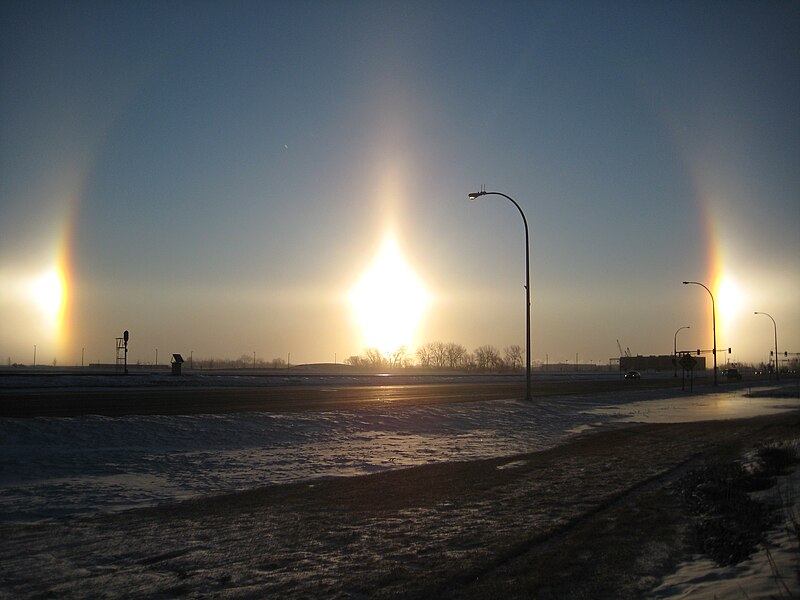
Sundogs in Fargo, North Dakota. Taken February 18th, 2009
On 1st November 2013, friday, three suns shone over the inner region of Mongolia in northern China. Well, contrary to the rumours, it was neither indications of doomsday nor magic. It was an atmospheric phenomenon known as "Phantom Sun" or "Sun dog". Its scientific name is Parhelion which means beside the sun.

It is an atmospheric phenomenon that creates bright spots of light in the sky, often on a luminous ring or halo on either side of the sun. Sundogs may appear as a colored patch of light to the left or right of the sun, 22° distant and at the same distance above the horizon as the sun, and in ice halos. 

How do they look?
Here's a video of the sun dogs observed in Mangolia on Friday.


How are they formed?
Phantom suns are commonly made by the refraction of light from hexagonal ice crystals (which are present in the high and cold cirrus clouds) which drift in the air at low levels. These crystals act as prisms, bending the light rays passing through them with a minimum deflection of 22°. If the crystals are randomly oriented, a complete ring around the sun is seen — a halo (as seen in the image below).

But often, as the crystals sink through the air, they become vertically aligned, so sunlight is refracted horizontally — in this case, sundogs are seen.

As the sun rises higher, the rays passing through the crystals are increasingly skewed from the horizontal plane. Their angle of deviation increases, and the sundogs move further from the sun. However, they always stay at the same elevation as the sun.


Read more ...

Solar Flip

Monday, October 7, 2013


Our Sun is about to flip! Yeah that's right but it doesn't mean that we need to flip out! The magnetic poles of the Sun are about to flip, that is, the North pole will become the South pole and vice versa. According to scientists at the Wilcox Solar Observatory at Stanford University , the Sun could be barely two to three months away from this magnetic field reversal. 

What does it mean?
The solar dynamo is the physical process that generates the Sun's magnetic field. The Sun is permeated by an overall dipole magnetic field, as are many other celestial bodies such as the Earth. It means that just like our earth has a magnetic field and thus, North and South poles, in a similar way Sun also has a giant magnet inside it with North and South poles. So we can think of the sun as a large N-S magnet, like our Earth, but with smaller variously oriented and continually evolving mini-magnets distributed over its photosphere (visible surface) and throughout its corona (extended atmosphere).

How does it flip?
Solar magnetic reversals occur close to solar maximum, when the number of sunspots is near its peak, though it is often a gradual process, taking up to 18 months. Indeed, as is the case now, one pole often lags the other by some months. Currently, the sun has two positive magnetic poles! "The sun's north pole has already changed sign, while the south pole is racing to catch up," says Scherrer. "Soon, however, both poles will be reversed, and the second half of Solar Max will be underway."

The reversal will probably be complete within the next one or two months. It happens at the peak of each solar cycle as the sun's inner magnetic dynamo re-organizes itself. The coming reversal will mark the midpoint of Solar Cycle 24. Half of 'Solar Max' will be behind us, with half yet to come.

The Sun's large scale magnetic field flips over on a regular basis, roughly every 11 years. Actually, Earth's flips too, very irregularly. The last time was 780,000 years ago. (PhysOrg)

Will it affect us?
Dibyendu Nandi, an astrophysicist at Kolkata's Indian Institute of Science Education and Research said, "The weather in space is expected to be most hazardous in the next few months as the flip begins to take place. The chances of solar magnetic storms occurring are also high. These storms carry a vast amount of charged particles and magnetic fields through interplanetary space and can pose a threat to satellite operations , telecommunications , air traffic on polar routes and power grids in countries at high latitudes". 

Scientists are watching the event closely to fully understand the changes that take place. It's also of special interest because the current solar cycle — the 24th since 1755, when sunspot activity began to be recorded — is one of the weakest in 100 years. A strong solar magnetic field also acts as a shield against cosmic rays coming from outer space. "Due to the current weak cycle, we have been recording high cosmic ray influx since 2009," said B N Dwivedi of IIT-BHU.

What we need to know is whether this flip leads to change in earth's magnetic field or not! Because that might lead to a lot of changes in our geographical  and climatic features.

Isha Khanna
Read more ...