Three suns shone over China: Illusion or magic?

Monday, November 4, 2013
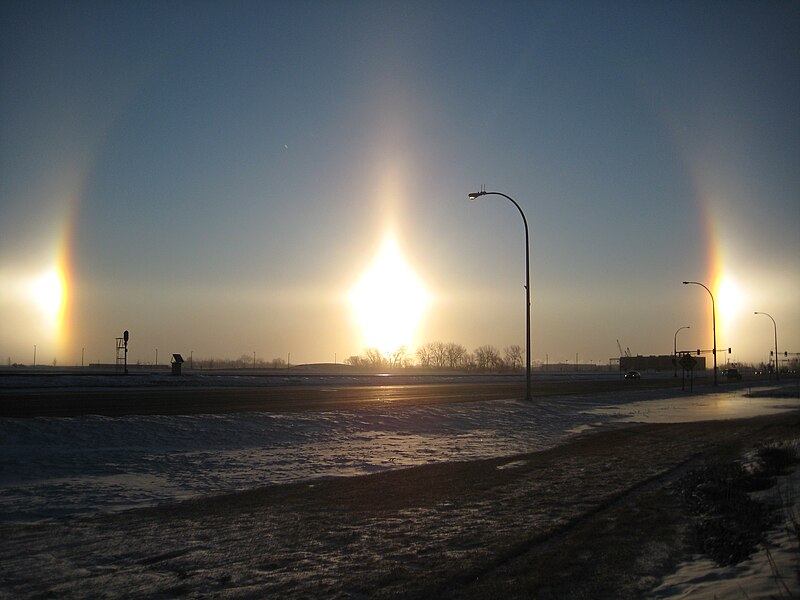
Sundogs in Fargo, North Dakota. Taken February 18th, 2009
On 1st November 2013, friday, three suns shone over the inner region of Mongolia in northern China. Well, contrary to the rumours, it was neither indications of doomsday nor magic. It was an atmospheric phenomenon known as "Phantom Sun" or "Sun dog". Its scientific name is Parhelion which means beside the sun.

It is an atmospheric phenomenon that creates bright spots of light in the sky, often on a luminous ring or halo on either side of the sun. Sundogs may appear as a colored patch of light to the left or right of the sun, 22° distant and at the same distance above the horizon as the sun, and in ice halos. 

How do they look?
Here's a video of the sun dogs observed in Mangolia on Friday.


How are they formed?
Phantom suns are commonly made by the refraction of light from hexagonal ice crystals (which are present in the high and cold cirrus clouds) which drift in the air at low levels. These crystals act as prisms, bending the light rays passing through them with a minimum deflection of 22°. If the crystals are randomly oriented, a complete ring around the sun is seen — a halo (as seen in the image below).

But often, as the crystals sink through the air, they become vertically aligned, so sunlight is refracted horizontally — in this case, sundogs are seen.

As the sun rises higher, the rays passing through the crystals are increasingly skewed from the horizontal plane. Their angle of deviation increases, and the sundogs move further from the sun. However, they always stay at the same elevation as the sun.


Read more ...

World's Lightest Material: Carbon Aerogel

Thursday, April 4, 2013
Scientists at Zhejiang University have produced a substance that is the World's lightest substance till date. It has the density equal to only one-sixth of the density of air.

Professor Gao Chao is the head of the team which built Carbon Aerogel, the solid material which has a density of only 0.16 mg/cubic centimetre. The earlier record of being the lightest material was held by Graphite Aerogel developed by a team of researchers at the University of Kiel and the Technical University of Hamburg in Germany in June 2012. 

Cabon Aerogel on the petals of a delicate flower but doesn't crush it .

The research team led by Professor Gao Chao freeze-dried solutions of carbon nanotubes and graphene to remove moisture and retain integrity. "Carbon aerogel is similar to carbon sponge in structure. When an aerogel of the size of a mug is put on Setaria, the slender grass will not bend," Gao Chao said in a statement. The study by Gao Chao was reported in the journal Advanced Materials.

The Indian Express reported it as excellent in elasticity as it can easily bounce back when compressed. In addition, it's one of the materials with biggest oil absorption capacity. Current oil absorbing products can usually absorb organic solvent of about 10 times of their own weight. The carbon aerogel newly developed can absorb up to 900 times their own weight.
"Carbon aerogel is expected to play an important role in pollution control such as oil spill control, water purification and even air purification," Gao Chao said.


Read more ...

China leading in air pollution, India not far behind!

Thursday, January 17, 2013
The reports about China's air pollution problem is flooding the newspapers. "National Environmental Analysis", a report prepared by the Asian Developmental Bank has observed that out of the world's 10 most polluted cities, 7 are in China. They are Taiyuan, Beijing, Urumqi, Lanzhou, Chongqing, Jinan and Shijiazhuang. While in Shanghai, air quality index, a new air quality reporting system that monitors sulfur dioxide, nitrogen dioxide, carbon monoxide, ozone, PM10 and PM2.5, reached 254 on Wednesday. The figure, highest in last two months, indicates that the air had reached the level of heavy pollution. Shanghai's hourly density of PM2.5, air particles smaller than 2.5 microns, also reached 250 micrograms per cubic meter by 10 am today, while the reading was only 60 micrograms per cubic meter early Tuesday morning! On the other hand, NASA images showed thick cloud covers over Beijing. According to their report, people in China are breathing air three times more toxic than what's hazardous to humans! Below is the comparison of the images prepared by NASA. 


(Click on the image for full-size image)

The image in the left (January 3, 2013) shows clear skies with lingering smog and haze on the ground whereas in the right image (January 14, 2013), we can observe dense cloud cover filled with the yellow/ gray tint of air pollution.

While China is in headlines these days, but reports suggest that India is not very far behind! In fact, a report by Tel Aviv University reports that Indian megacities are seeing a double-digit increase in pollution than the cities in the classic environmental villain to the east, China. It states that from 2002 to 2010, Bangalore saw the second highest increase in air-pollution levels in the world at 34%, and Indian cities including Pune, Mumbai, Nagpur and Ahemdabad, are not very far behind. In Delhi, it is reported many times that the PM 2.5 rose above 500mg/cu whereas the normal levels should be only 60 to 80 mg/cu as per Indian national quality standards.

It is an upcoming issue and needs to given priority as according to World Heath Organisation, more than 2 million people die every year due to air pollution. A study showed that 3.2 million people died from air pollution in 2010, compared to 8,00,000 in 2000. The annual Global Burden of Disease (GBD) report ranked air pollution in the world's top 10 list of killer disease for the first time. It reported 1.2 million deaths a year in east Asia and China, and 712,000 in south Asia, including India. We do not have medicines or drugs to cure air pollution except for the controlling the emissions from anthropogenic activities! Hope we can control our own activities and solve the problems!

Read more ...