Modern healthcare is really touching our lives these days. Due to the upcoming advances in technology and instrumentation, we are able to save a large number of lives. Also, the average life expectancy has increased due to better medical facilities which are helping to cure the previously untreatable diseases by the discovery of new drugs. Also, the attempt is to reduce the treatment costs so that everyone is able to afford the treatments. One such disease I am going to talk about is Atrial Fibrillation.
Atrial fibrillation (AF or A-fib) is the most common cardiac arrhythmia which is the condition of irregular heartbeat Our heartbeats follow a periodic cycle and any irregularity in that cycle causes very critical problems. AF may be asymptomatic in some cases which means it does not present any symptoms, but it is often associated with palpitations, fainting, chest pain, or congestive heart failure.
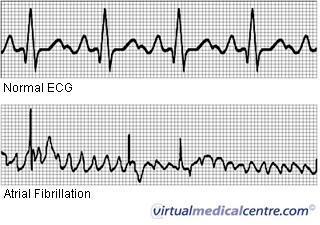
The major problem with AF is that it increases the risk of stroke; the degree of stroke risk can be up to seven times that of the average population, depending on the presence of additional risk factors (such as high blood pressure). It may be identified clinically when taking a pulse, and the presence of AF can be confirmed with an electrocardiogram (ECG or EKG) which demonstrates the absence of P waves together with an irregular ventricular rate (P waves are present as the small peak just before the longer peak in the ECG curve).

The main goals of treatment are to prevent circulatory instability and stroke. The rate or rhythm control are used to achieve the former, while anticoagulation is used to decrease the risk of the latter. Now new technologies like Catheter- Ablation have been developed which help in controlling the rhythm of the heartbeat. It is an invasive procedure used to remove a faulty electrical pathway from the hearts of those who are prone to developing cardiac arrhythmias such as atrial fibrillation.
In catheter ablation, one or more thin, flexible wires, called catheters are inserted into a blood vessel (usually the groin) and guided into the heart. Each catheter has two or more electrodes to measure the heart's electrical signals as they travel from one chamber to another. RF catheter is inserted into a blood vessel and guided into the heart to pinpoint the source of the abnormal electrical signals. These catheters used to deliver a low-voltage, high-frequency current that destroys the heart tissue responsible for the arrhythmia. Majority of the patients who have undergone catheter ablation experience either:
- return to normal heart rhythm,
- long term reduction in the number of episodes of arrhythmia and the severity of symptoms.
This means that medicines for controlling heart rate or rhythm may be stopped or reduced following successful catheter ablation.
 |
| Catheter Ablation |
Apollo Hospitals Chennai is the first hospital in the country to get the latest 3D mapping technology in arrhythmia management. The latest technology [CARTO 3 System] gives the three-dimensional view of the patient' s heart which helps the Electrophysiologist to identify the site of origin of the abnormal rhythm accurately and deliver the Radiofrequency catheter ablation therapy with high success rate.
The benefits of the curative catheter ablation therapy are mentioned below.
- Better Quality of Care: Most cardiac arrhythmias can be treated and cured by catheter ablation thereby eliminating the need for life-long therapy.
- Better Quality of Life: Catheter Ablation can restore the quality of life of the patient leading to a happier family life and improved productivity at workplace.
- Saves Lives: Some life-threatening Ventricular Arrhythmias can be successfully treated with catheter ablation thereby providing patients with an option to live.
- Cost-effective : The overall lifecycle costs of care for the patient may be reduced due the curative nature of catheter ablation therapy. Alternative device therapies can be more than five times costlier.
- Catheter ablation is considered safe and is not associated with a significant risk, so the chance of experiencing complications is low. And it is a keyhole procedure which allows the patient to get back to their work soon after the procedure.